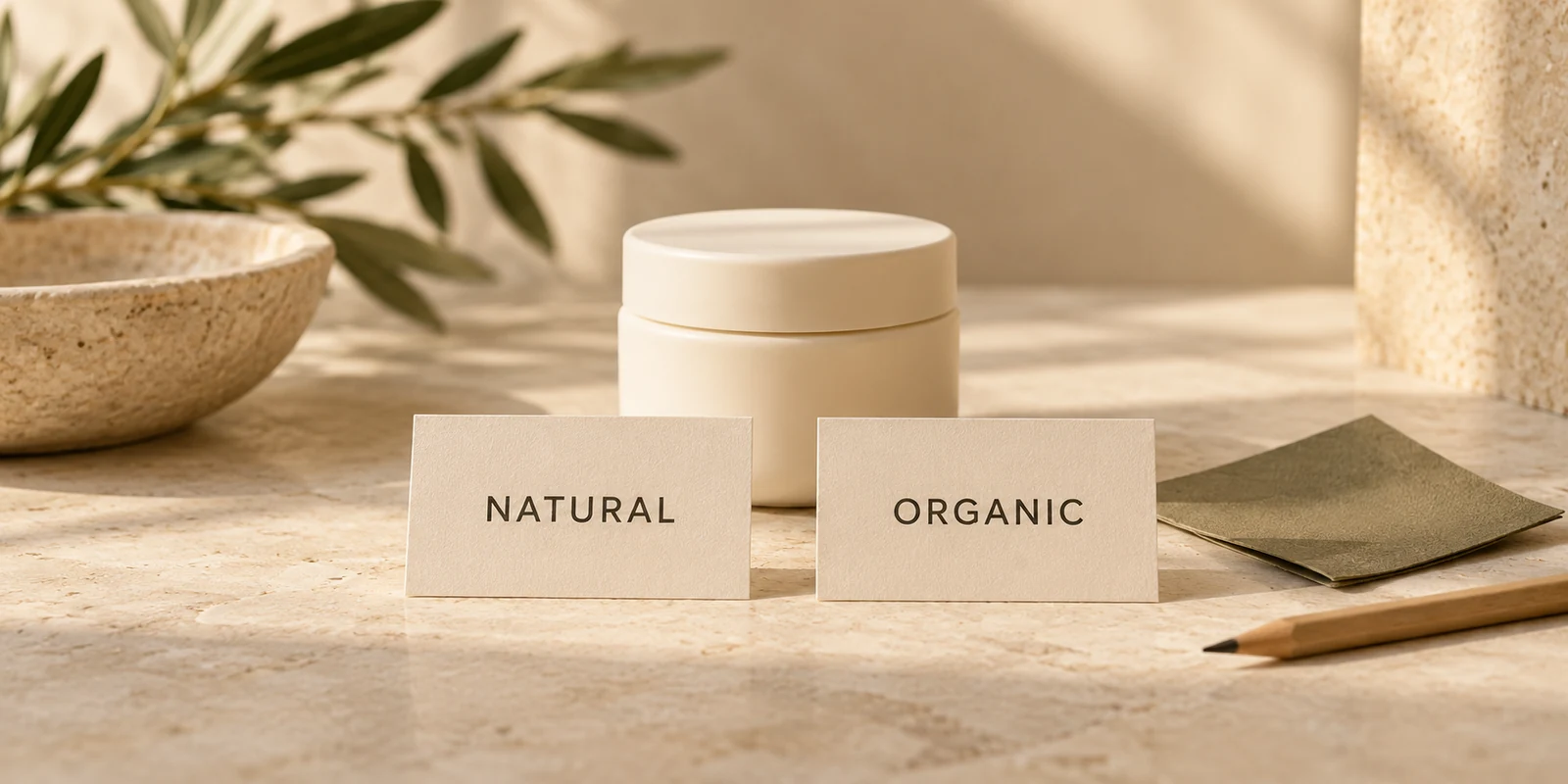
Natural and organic describe different things on skincare labels. In the United States, FDA has not defined natural for cosmetics. Eligible products can meet USDA organic standards, which address how agricultural ingredients are produced and how products qualify for particular claims. Neither word, by itself, tells you whether a formula will suit your skin.
This guide helps adults read everyday cosmetic labels in the US. It focuses on the meaning and scope of the claims, rather than ranking products or giving manufacturers a compliance checklist.
Start with the exact wording
A leafy package and the word natural may suggest an ingredient story, but they do not identify a single FDA-defined cosmetic standard. FDA explains that it has not established a regulatory definition of natural for cosmetic labeling. The usual safety and labeling requirements still apply, including truthful, nonmisleading claims.
Ask what the company means by the word. Is it describing one ingredient, a sourcing policy, or a standard applied to the finished product? A clear answer is more useful than treating natural as a complete product description. Keep the original wording in your notes instead of translating it into organic, fragrance-free, or another claim the package does not make.
Understand the USDA organic categories
USDA says cosmetics containing agricultural ingredients may qualify for its National Organic Program when they meet the relevant production, handling, processing, and labeling requirements. That is a specific certification framework, not an automatic consequence of including a plant-derived ingredient.
Within that framework, USDA distinguishes four labeling categories. The percentages below exclude water and salt; additional conditions apply beyond the percentage.
| Category | Organic content | USDA organic seal |
|---|---|---|
| 100 percent organic | 100% | Permitted |
| Organic | At least 95% | Permitted |
| Made with organic [specified ingredients or categories] | At least 70% | Not permitted |
| Specific organic ingredients identified in the ingredient statement | Below 70% | Not permitted |
The made-with category names up to three ingredients or ingredient categories. USDA does not allow the bare phrase “made with organic ingredients” as that front-label claim. In the below-70% category, organic identification belongs in the ingredient statement, not an organic claim on the front panel.
Seal use is optional for qualifying certified products in the first two categories. Its absence alone does not tell you which standard a product meets. Read the claim and certification information together.
Separate an ingredient claim from a product claim
An organic ingredient named in a formula is one piece of information. Certification of the finished product is another. Do not assume the first establishes the second.
There are also private certification systems. USDA’s cosmetics factsheet notes that products may be certified to other private standards. An unfamiliar mark is a reason to identify the standard and certifier, rather than assume it is either a USDA seal or a meaningless decoration.
For the separate task of interpreting ingredient names and their order, see our skincare ingredient-list guide. Counting names on that list is not a way to calculate a product’s organic percentage.
Keep safety and personal fit as separate questions
FDA states that an ingredient’s source does not determine its safety. Plants can contain allergenic substances whether or not they were organically grown. Organic claims also do not replace the safety and labeling obligations that apply to cosmetics.
You can care about sourcing while still checking the formula’s intended use, directions, and how it fits your needs. Keep a preference for a production standard separate from a prediction about comfort or results. Neither natural nor organic is a reason to overlook an ingredient you already know you need to avoid.
Use a three-question label check
Before letting a front-label word settle a purchase, write down these three answers:
- What is the exact claim? Copy the wording, including any named ingredients.
- Which standard supports it? Look for the named certification system and certifier; ask the manufacturer if that information is unclear.
- What does it cover? Distinguish an ingredient, the finished product, and a broader company policy.
This is a way to organize your reading, not score a product’s safety. If organic sourcing matters to you, it can be one selection criterion alongside texture, price, and practical use. You do not need to replace a comfortable basic skincare routine merely because a new label sounds more appealing.
Sources and editorial note
Sources were checked on October 30, 2026. Labeling context applies to the United States. This educational guide was prepared with AI assistance and checked against the linked sources. It has not been reviewed by a dermatologist. No products were tested. The cover is an AI-generated editorial illustration, not real packaging or certification. Read our Editorial Policy for sources and disclosures.


The conversation