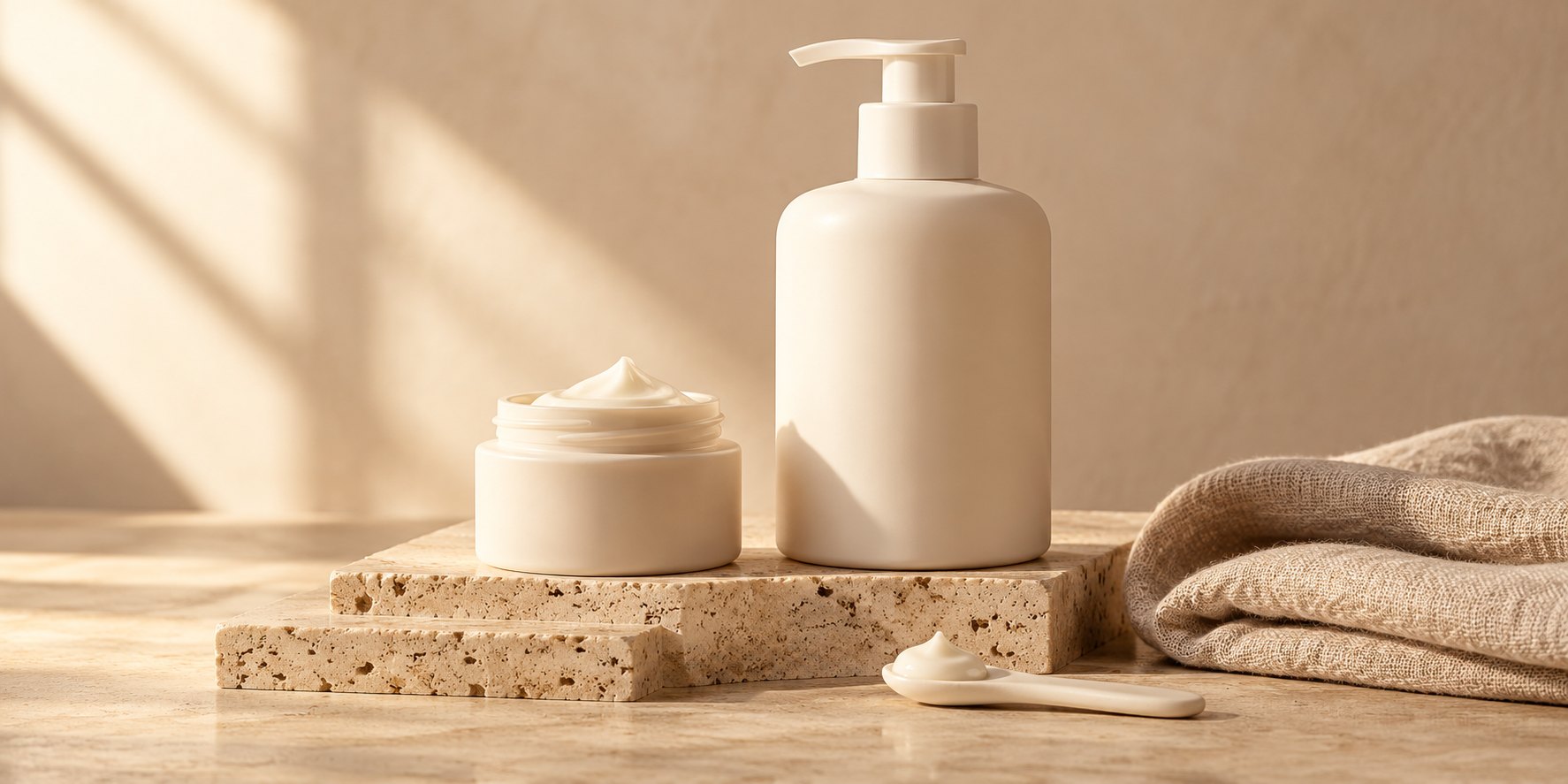
A large bottle of body lotion can look like a better deal than a small face cream. Before deciding whether one can replace the other, check the actual product: its intended use, directions, texture, ingredients and price. The words “face” and “body” are a starting point, not enough information to judge a formula.
This guide compares ordinary moisturizers. It does not assume that every body lotion belongs on the face, or that every facial moisturizer is a necessary upgrade. Start with the product you already own and the job you want it to do.
Start with the intended use
Read the front, back and any outer carton. Does the manufacturer describe use on the face, body or both? Are there eye-area warnings or other limits? If the directions exclude a place you want to apply it, choose a product intended for that use instead of treating the larger bottle as an automatic substitute.
The FDA’s cosmetics-labeling summary explains that a cosmetic label identifies the product’s nature or use and net contents, and that retail cosmetics generally require an ingredient declaration. Find these details before relying on a shop’s category name or a photograph of the front panel.
A familiar-looking package can also contain a different kind of product. The FDA distinguishes ordinary moisturizers from sunscreen and acne treatments; SPF moisturizers fall under both cosmetic and drug requirements in the United States. Follow the relevant directions and warnings. This guide does not compare medicated lotions or replace their instructions.
Compare these five things
| Check | Useful question |
|---|---|
| Intended area | Does the manufacturer describe the use I have in mind? |
| Texture | Will this finish be practical on that area? |
| Ingredient list | Does it include anything I already know I must avoid? |
| Other routine steps | Will it fit alongside the products I actually use? |
| Quantity and price | Am I comparing the same units and a usable pack size? |
Texture matters, but the name has limits
The American Academy of Dermatology describes several moisturizer textures: gels tend to feel lighter; creams and ointments are generally richer. A format name cannot predict every finished formula.
For example, a product you enjoy on your hands might leave a finish you dislike under facial sunscreen or makeup. That is a reason to reconsider that particular combination, rather than proof that every body lotion behaves the same way. Our lotion, cream and ointment guide explains the format vocabulary in more detail.
Read beyond the highlighted ingredient
Two packages can highlight the same ingredient while giving you different directions, textures and ingredient lists. Put them side by side rather than comparing only the words on the front. Our ingredient-list guide can help you recognize what the list does and does not reveal.
In particular, do not calculate an ingredient percentage from its position alone. The FDA allows ingredients at one percent or less to appear without descending concentration order. The list is useful for identifying ingredients, not for reconstructing a formula or proving that one moisturizer will perform better.
If scent is part of your decision, check the actual labeling instead of assuming that all face products are fragrance-free or that all body products are scented. See fragrance-free versus unscented for that separate label question.
Decide whether sharing a bottle makes sense
Consider a hypothetical choice between a large lotion labeled for face and body and a smaller face cream. If the larger product fits the intended use and you prefer its feel, its size may be convenient. If its finish makes you avoid using it on your face, the larger pack may not be useful value for that job.
Compare price per ounce only between matching units: fluid ounces and weight ounces are different measures. Also ask whether you can use the quantity you are buying. A discount on a bottle you do not want to use is a poor reason to replace a comfortable routine.
If hands are the main concern, our hand-moisturizing guide offers a more focused place to start. You do not need a separate facial purchase simply to make a routine look complete.
Introduce a change carefully
The AAD recommends trying a new product on a small area twice daily for seven to ten days, using it as directed. A home trial cannot guarantee that a later reaction will not occur. Stop using a product that causes a reaction and seek advice for severe or persistent symptoms.
Sources and editorial note
Sources were checked on October 31, 2026. Labeling references apply to products sold in the United States. The comparison questions and examples are an editorial decision aid, not a product test or an individual treatment plan.
This educational guide was prepared with AI assistance and checked against the linked sources. It has not been reviewed by a dermatologist. No products were tested for this article. It does not replace individual medical advice.
Read our Editorial Policy for how we handle sources, AI assistance, and corrections.
The conversation