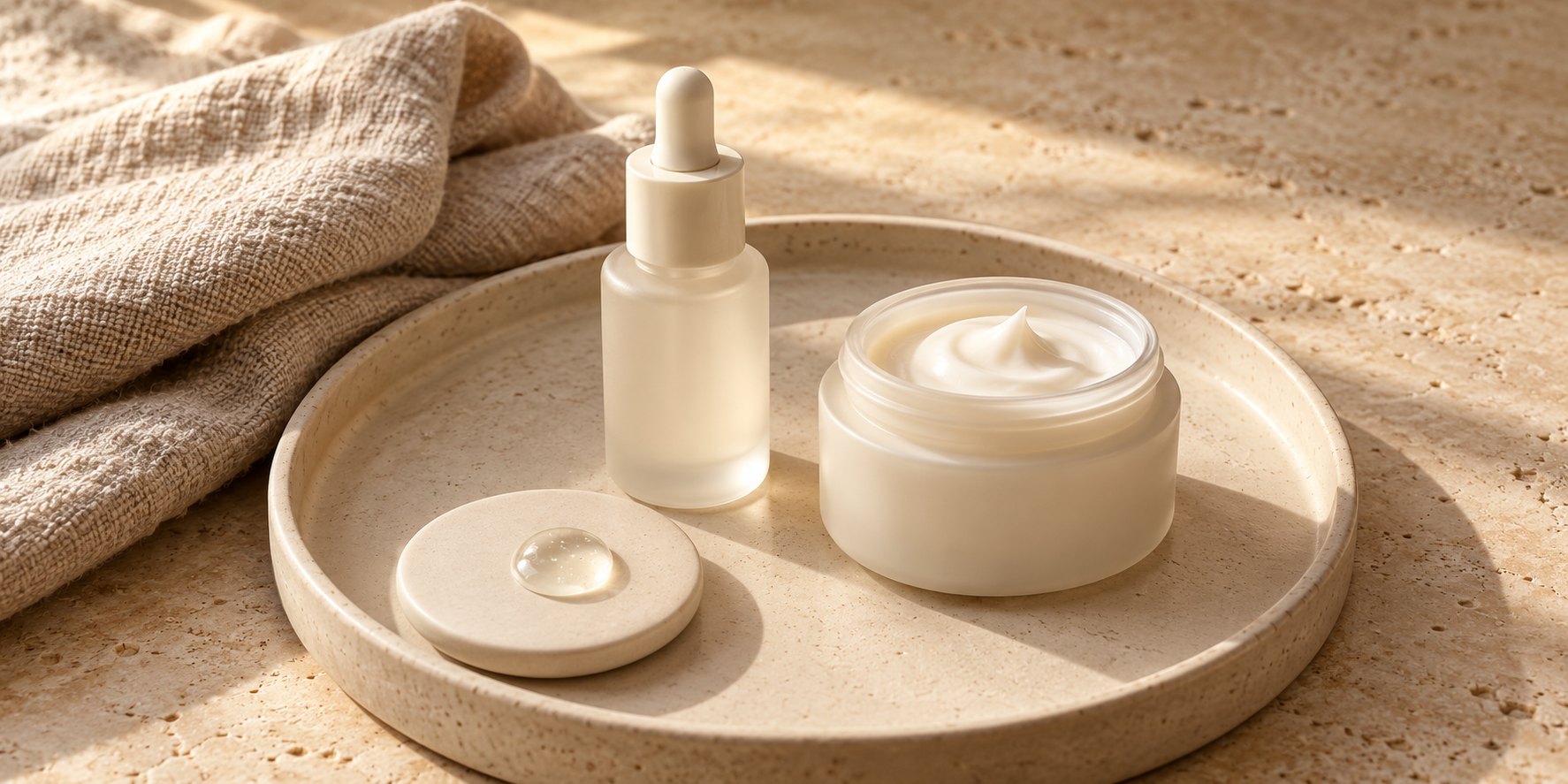
You do not automatically need a hyaluronic acid serum as well as a moisturizer. Hyaluronic acid is an ingredient, while serum and moisturizer describe products that may share ingredients and purposes. A moisturizer can already include hyaluronic acid alongside other moisturizing components. The useful question is what an additional bottle would contribute to your existing routine.
This guide is about topical cosmetic products, not injectable fillers, supplements or treatment for a diagnosed skin condition. It offers a way to make the purchase decision without assuming that more steps mean better care.
An ingredient and a product category are different things
Hyaluronic acid has water-binding properties and is used as a humectant. A moisturizer may combine humectants with ingredients that soften skin and reduce water loss. DermNet describes these overlapping components of moisturizers. A bottle labeled serum does not tell you its complete formula or whether it fills all the roles you want.
Our guide to humectants, emollients and occlusives explains the roles in more detail. They are not three separate products everyone needs to buy. Likewise, “hyaluronic acid” on two labels does not make the finished products identical.
What research can tell you about the extra step
In a 2011 randomized study involving 76 women, participants used one of several hyaluronic-acid creams around one eye and a vehicle-control cream around the other for 60 days. The tested HA creams improved measured hydration compared with their controls.
That is evidence about particular cream formulas, not proof that every HA serum adds a benefit to every moisturizer. It also shows why ingredient research should not be read as a shopping instruction: hyaluronic acid was delivered in a cream. The abstract does not answer whether your current moisturizer plus a separate serum would outperform your moisturizer alone.
When reading a product claim, ask whether the finished formula was studied, what it was compared with, and which result was measured. A result for a different product does not become evidence for the bottle you are considering because both labels mention HA.
A practical way to decide whether you need both
| Your starting point | A useful next question |
|---|---|
| Your current moisturizer is comfortable and suits your routine | What specific problem would the serum solve? If there is no clear answer, keeping the routine unchanged is reasonable. |
| You dislike your moisturizer’s texture | Would choosing a more suitable moisturizer address the issue more directly than adding another layer? |
| You want to try a serum you already own | What do its directions say, and can you assess this one change without replacing the rest of your routine? |
| Dryness or irritation persists | Would individual assessment be more useful than buying another ingredient-led product? |
If texture is the sticking point, compare lotion, cream and ointment formats. If a moisturizer highlights ceramides, our ceramide guide explains why that ingredient also needs to be considered within the whole formula. You do not need a separate serum to complete an ingredient collection.
If you choose to try a serum
Read the directions on both products before combining them. Do not assume a universal number of drops, a mandatory waiting time, or that every formula must be applied to wet skin. Keep any clinician-directed treatment instructions in place. Our beginner routine guide provides the broader structure, including sun protection.
The AAD recommends testing a product on a small area, following its directions, twice daily for seven to ten days. This home check differs from medical patch testing and cannot guarantee later tolerance. Stop a product causing a reaction; seek advice for severe or persistent symptoms.
For your own comparison, record the product, the change you made and whether the extra step is comfortable and practical. Those observations can inform your routine, but they cannot identify which ingredient caused a result or establish clinical efficacy.
Make room in the budget only for a useful step
The AAD’s budget guidance centers a simple routine on cleansing, moisturizing and sun protection. An HA serum can be an optional preference rather than a baseline requirement. Compare its ongoing cost with the routine you already have, and leave a working moisturizer in place when there is no clear reason to change it.
Sources and editorial note
Sources were checked on October 31, 2026. The cited study concerns specific topical creams; this article does not establish that a serum and moisturizer combination is superior to a moisturizer alone. The decision table is an editorial worksheet, not a diagnostic tool.
This educational guide was prepared with AI assistance and checked against the linked sources. It has not been reviewed by a dermatologist. No products were tested for this article. It does not replace individual medical advice. Read our Editorial Policy for our approach to sources and corrections.

The conversation