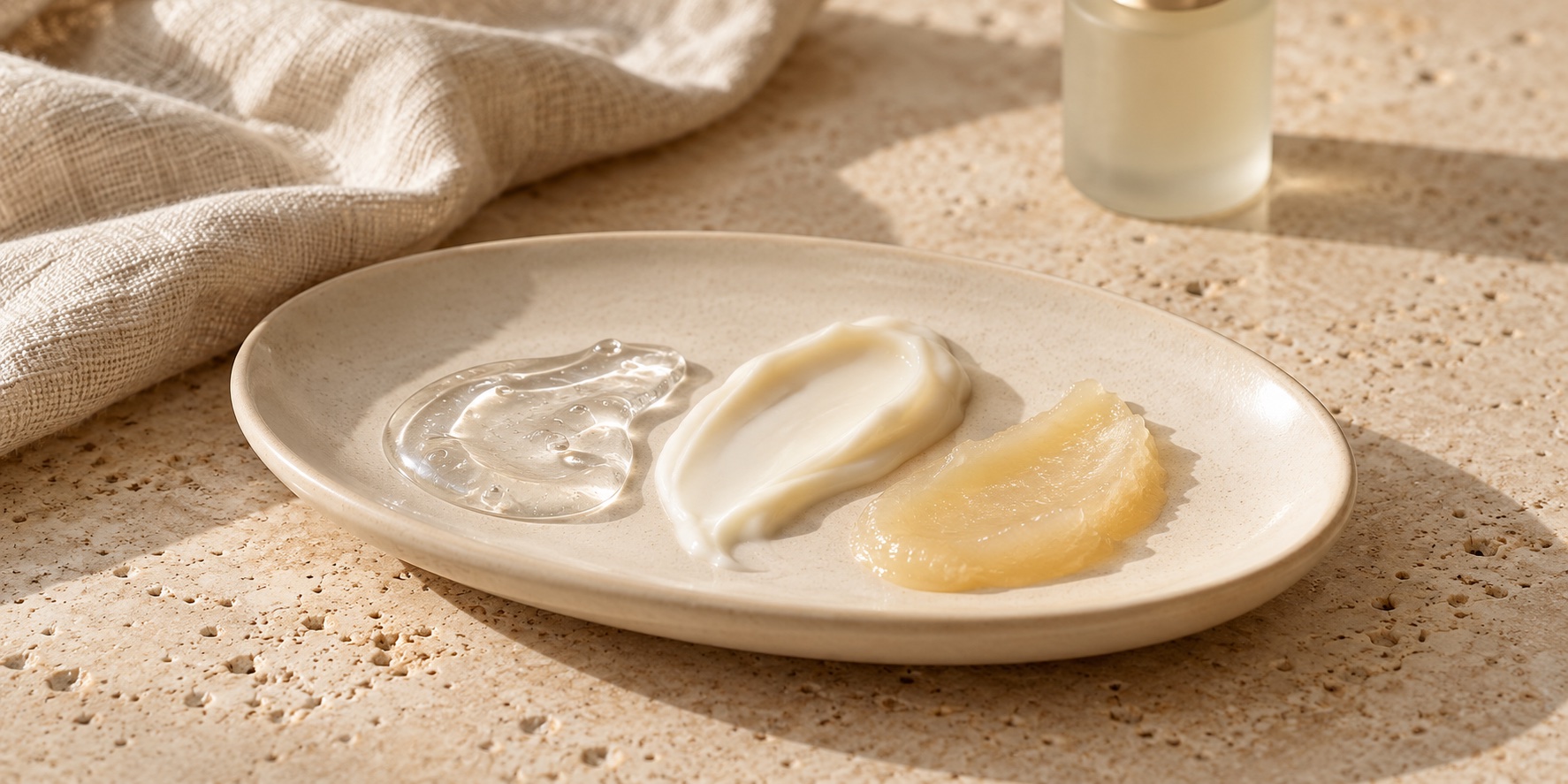
Humectants help attract and hold water in the skin’s outer layer. Emollients soften and smooth its surface. Occlusives help slow water escaping from it. These are ingredient roles, and a moisturizer can combine all three in one formula. Understanding the difference can make a label easier to read without turning your routine into a three-product shopping list.
This guide is for adults choosing an everyday moisturizer. It explains what the ingredient groups do, where their jobs overlap, and what they cannot tell you about a finished product.
Three roles at a glance
| Role | Main job | Examples |
|---|---|---|
| Humectant | Attracts and retains water in the outer skin layer | Glycerin, urea |
| Emollient | Improves softness and surface smoothness | Glyceryl stearate, lanolin |
| Occlusive | Forms a layer that reduces evaporative water loss | Petrolatum, mineral oil, dimethicone |
DermNet’s moisturizer guide describes these functions and examples.
What is a topical emollient? Types and examples
A topical emollient is a moisturizing product applied directly to the skin. In patient guidance, “emollient” often means the whole product: the NHS lists lotions, creams and ointments among emollient formats. In an ingredient discussion, the same word describes a softening and smoothing role. These are two different ways to classify skincare products and their ingredients.
| What is being classified? | Examples | What it tells you |
|---|---|---|
| Finished product format | Lotion, cream, ointment | The form of the product you apply |
| Ingredient function | Humectant, emollient, occlusive | A job ingredients perform within a formula |
For example, lanolin and glyceryl stearate are emollient ingredients; an emollient cream or lotion is a finished formula. The two classifications do not map one-to-one: a cream or lotion can combine humectants, emollients and occlusives.
The categories overlap
An ingredient does not always belong in only one column. Dimethicone, for example, can have both smoothing and occlusive properties. A published analysis of moisturizer ingredients explicitly describes that overlap. The table is a reading aid, not a strict classification test.
Likewise, seeing glycerin in a moisturizer does not make it “just a humectant.” The same product may include oils, silicones, or other ingredients with different functions. A review of moisturizer formulations explains why these components are commonly combined and why the vehicle—the formula that carries them—matters.
A practical example: if a product lists glycerin and dimethicone, you can recognize water-retaining and water-loss-reducing roles in that list. You still cannot calculate how moisturizing the product will feel or whether you will enjoy using it. That requires information about the whole formula and your experience with it.
Use the terms to ask better questions
Instead of choosing a winner among the three groups, start with the job you want your moisturizer to do. Is your main concern a rough-feeling area, a texture you dislike, or a routine that has become unnecessarily complicated? These are useful observations to bring to a purchase decision; they are not diagnoses of what your skin lacks.
Try this short label-reading exercise with a product you already own:
- Read its intended use and application directions.
- Identify one ingredient role you recognize, without trying to classify everything.
- Write down what you still do not know, such as exact amounts or how the texture will feel.
- Decide whether the product already meets your needs before buying another step.
For the texture decision, our lotion, cream, and ointment guide is a useful next read.
If your label also highlights ceramides, our ceramides guide explains their place in the skin barrier and the limits of finished-product claims. Recognizing one ingredient does not replace assessing the whole moisturizer.
What the ingredient list cannot settle
For cosmetics sold in the United States, ingredients generally appear in descending order of predominance, but ingredients at one percent or less can be listed in any order; color additives also have an exception. The FDA explains these labeling rules. A list therefore does not reveal the exact concentration of every ingredient, and a lower position alone does not establish that an ingredient is useless.
Nor does a longer list of recognizable moisturizing ingredients prove that one product is better. Treat ingredient recognition as a way to understand a product, rather than a points system. If two products both look plausible, practical details such as directions, fragrance, texture, and replacement cost can make the choice clearer. For a closer look at names and ingredient order, see how to read a skincare ingredient list.
Keep application simple
The American Academy of Dermatology’s dry-skin guidance recommends applying moisturizer promptly after washing, while skin is still damp, and choosing fragrance-free products. Follow your product’s directions and any instructions for prescribed treatments.
You do not automatically need a humectant serum, a separate emollient cream, and an occlusive top layer. Start with a suitable moisturizer within a manageable basic routine. If dryness persists, or products repeatedly burn or sting, ask a dermatologist for advice rather than continuing to add layers.
For that specific shopping decision, see hyaluronic acid serum versus moisturizer: it explains when a separate hydration step may be unnecessary and how to compare the finished products.
Sources and editorial note
Sources were checked on October 27, 2026. The ingredient-list rules discussed above apply to US cosmetic labels. Examples illustrate ingredient roles; they are not endorsements or a ranking of products. The explanation of topical emollients, product formats and ingredient roles was rechecked against NHS and DermNet guidance on November 1, 2026.
This educational guide was prepared with AI assistance and checked against the linked sources. It has not been reviewed by a dermatologist. No products were tested for this article. It does not replace individual medical advice.
Read our Editorial Policy for how we handle sources, AI assistance, and corrections.


The conversation