Choose a lip balm that feels comfortable, helps limit moisture loss, and fits where you will use it. For outdoor use, look specifically for broad-spectrum SPF 30 or higher. A pleasant texture and a sun-protection label answer different questions; one should not stand in for the other.
This guide helps adults compare everyday lip-care products without building a collection of balms, scrubs, and masks. It covers ordinary cosmetic care, not the diagnosis or treatment of persistent lip problems.
Start with a comfortable protective formula
A balm’s protective layer can help reduce moisture escaping from your lips. Cleveland Clinic’s lip-care guidance favors ointment-based products with ingredients such as petrolatum or mineral oil. Plain petroleum jelly intended for this use is one option, not a requirement or a claim that every other formula is inferior.
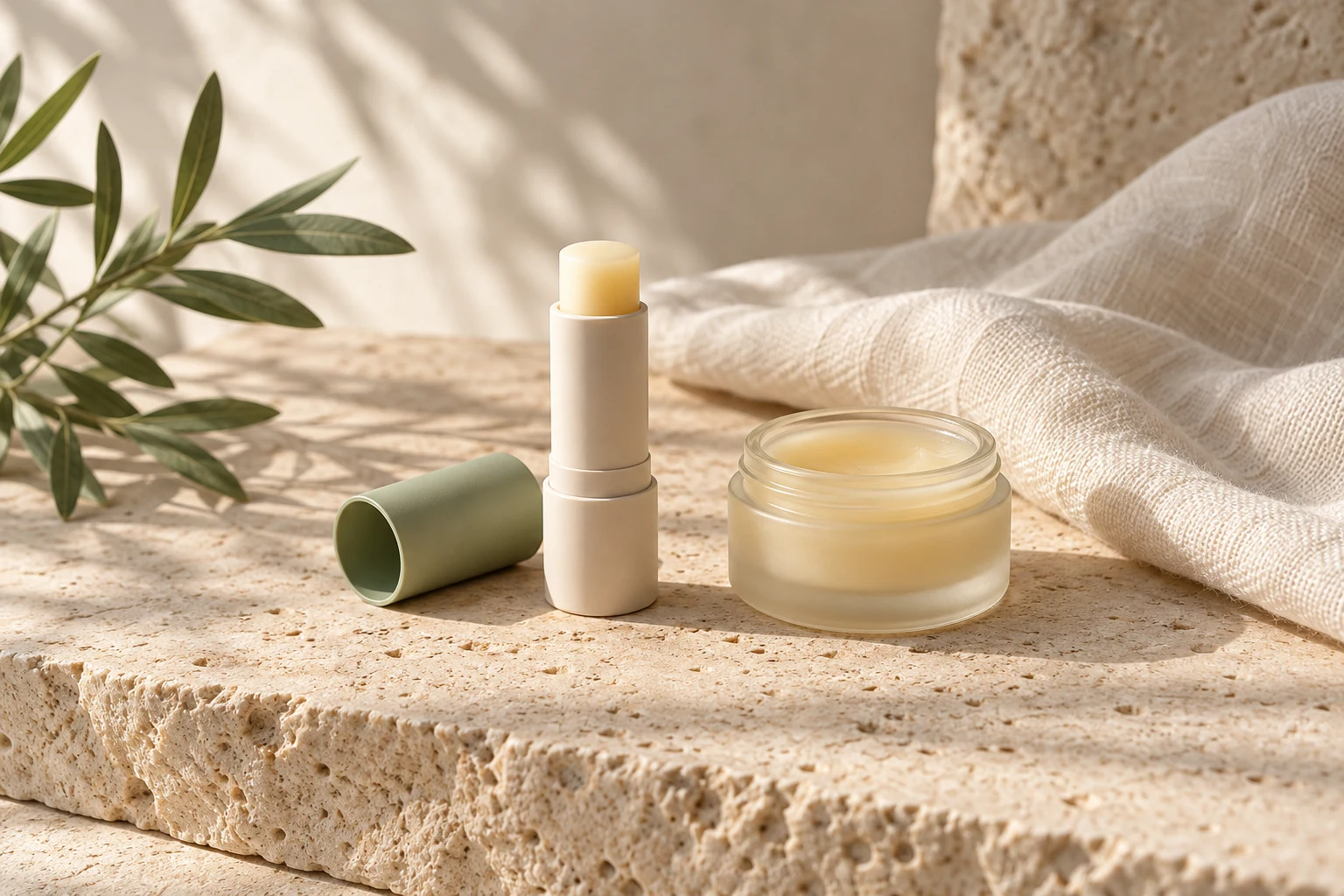
Keep the choice practical. Can you apply it comfortably, follow its directions, and carry it when you need it? A stick, tube, or pot is a delivery format—not proof of better performance. If the product you already use meets those needs, this checklist may confirm your choice rather than create another purchase.
For the broader ingredient vocabulary, our guide to moisturizing ingredient roles explains how reducing water loss differs from attracting water. There is no need to classify every ingredient before choosing a lip balm.
Do not use a tingle as a quality test
The American Academy of Dermatology (AAD) advises stopping lip products that burn, sting, or irritate. That sensation is not evidence of effective care. Its advice for already chapped lips includes avoiding fragrance and ingredients such as menthol, camphor, and eucalyptus.
Cleveland Clinic independently cautions that these cooling ingredients can be drying or irritating and recommends a simple, fragrance-free approach. This is not a claim that every fragranced product harms everyone. It is a reason to prioritize comfort over a cooling sensation, particularly when your lips are dry.
Read the package rather than judging by scent alone. If a description is unclear, ask the manufacturer. Our ingredient-list guide explains what a US cosmetic declaration can—and cannot—tell you.
Make a separate check for outdoor protection
For lips, the AAD specifically recommends lip balm with SPF 30+ and broad-spectrum protection. Look for both on the label. Do not infer SPF from a thick coating, an ingredient name, or a product being sold as a balm.
Apply before going outdoors and reapply every two hours outdoors, as advised by the AAD and Cleveland Clinic. Read the particular product’s application and reapplication directions too. Our sunscreen label guide explains the protection terms; this article keeps the focus on choosing a lip product you will actually use.
You do not automatically need separate indoor and outdoor products. A comfortable balm with the appropriate sun-protection labeling may cover both needs. The important distinction is between the two checks—not a rule to buy two containers.
Use this two-question shopping check
- Comfort: Is this intended for lip use, are its directions clear, and does it feel comfortable rather than irritating?
- Outdoor use: If I will use it outside, have I found an explicit broad-spectrum statement and SPF of at least 30?
Write down an unanswered question instead of filling the gap with a marketing promise. A product can pass your comfort check while leaving sun protection unresolved. Conversely, a suitable SPF label is not a reason to keep using a product that irritates your lips.
Keep everyday care gentle
Avoid licking, biting, or picking at your lips. Both the AAD and Cleveland Clinic explain that licking can worsen dryness. Reaching for a comfortable balm is a more useful response than repeatedly wetting your lips with saliva.
If ordinary care is not helping, seek professional advice rather than cycling through more products. MedlinePlus specifically advises seeing a healthcare provider for lip sores that do not heal. A shopping checklist cannot determine the cause of an ongoing problem.
Sources and editorial note
Sources were checked on October 29, 2026. This general guide is written for US adult readers and was prepared with AI assistance, then checked against the linked sources. It has not been reviewed by a dermatologist. No products were tested. The cover is an AI-generated editorial illustration, not a photograph of tested products. Read our Editorial Policy for sources and disclosures.