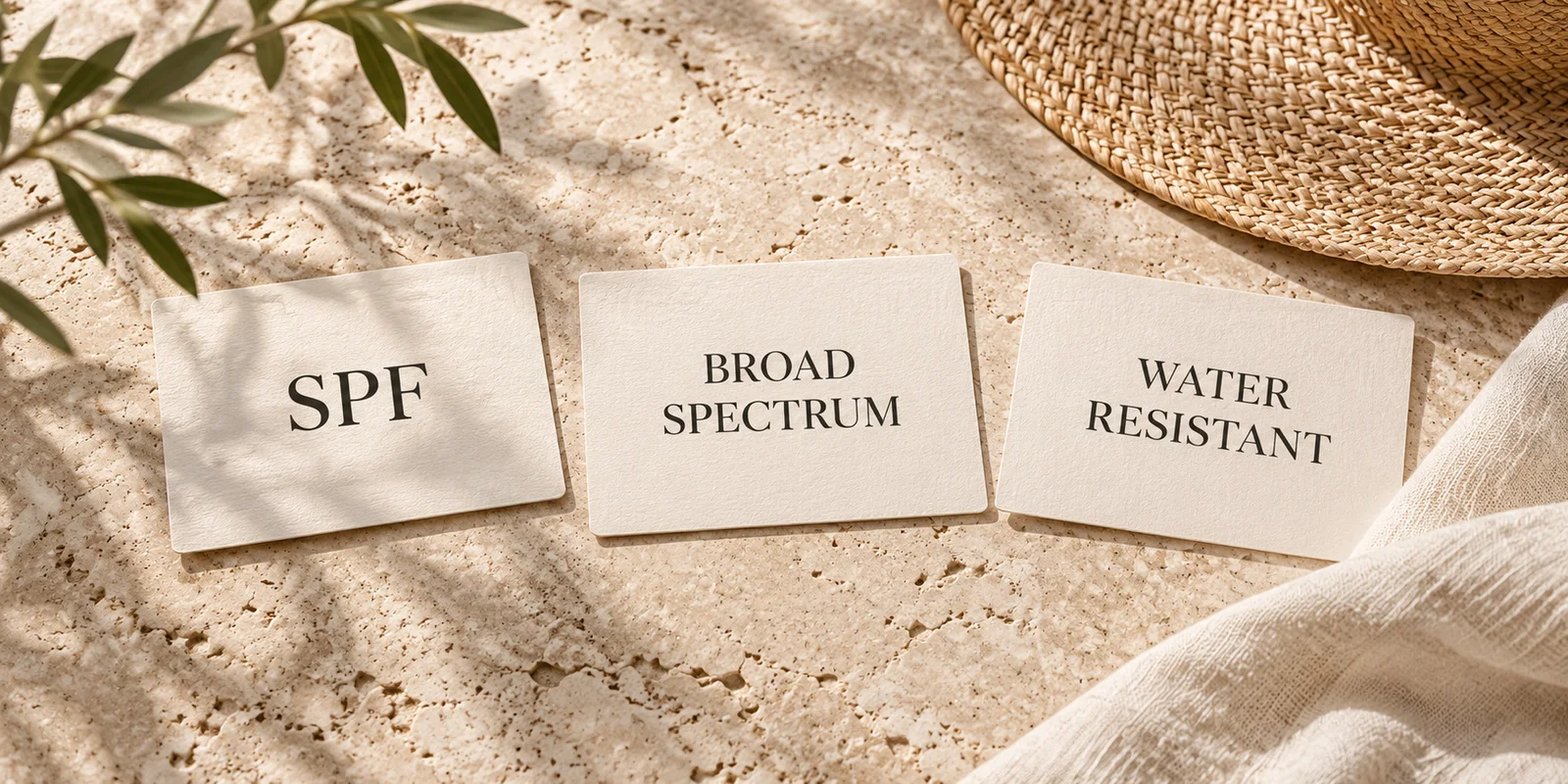
Read a US sunscreen label in this order: look for broad-spectrum protection, an SPF of 30 or higher, and water resistance; then turn the package around and read the directions. That three-part starting point follows the American Academy of Dermatology’s sunscreen selection guidance. The biggest number on the front is not the whole decision.
This guide is for adults comparing sunscreen sold in the United States. Rather than ranking brands or filters, it separates what the front label tells you from what you still need to check before use.
Three label details, three different questions
| Label detail | The question it answers | What not to assume |
|---|---|---|
| Broad spectrum | Does it cover both UVA and UVB rays? | A large SPF number alone answers this. |
| SPF | How does its tested sunburn protection compare? | The number is a timer for safe sun exposure. |
| Water resistant, 40 or 80 minutes | What tested water-resistance interval is stated? | It is waterproof or will last all day. |
Keep these as separate checks. A package can make one detail very prominent while another takes a closer look. The FDA explains the distinction between SPF, broad-spectrum coverage, and water resistance.
Broad spectrum is not another SPF number
SPF primarily describes protection against UVB-related sunburn. Broad-spectrum labeling adds the important information that a sunscreen also protects against UVA. Look for the actual words rather than inferring coverage from the product’s price, color, or placement on the shelf.
The AAD’s label guide also emphasizes that no sunscreen filters every UVB ray. Sunscreen belongs alongside shade and sun-protective clothing, not in place of them.
SPF is not a time allowance
SPF compares the ultraviolet exposure needed to produce sunburn with and without sunscreen under testing conditions. It does not tell you how many minutes or hours you can stay outside without burning. The FDA’s SPF explanation makes this distinction explicitly.
For example, do not multiply a familiar time outdoors by the SPF number to plan your afternoon. Sun intensity, the amount applied, and reapplication all affect real-world exposure. A higher number does not remove the need to follow directions.
You may notice different numbers in official advice: FDA’s general sun-safety guidance starts at broad-spectrum SPF 15, while AAD recommends SPF 30 or higher. This guide uses AAD’s SPF 30-plus selection recommendation; it is not claiming that 30 is a universal US legal minimum.
Water resistant does not mean waterproof
On a US label, a water-resistance claim states either 40 or 80 minutes of swimming or sweating. It is a tested interval, not a promise that the product cannot wash off. The FDA says there is no waterproof sunscreen.
For a swim or sweaty outdoor activity, find that interval before leaving home. Then read the reapplication directions rather than relying on a vague memory of the front label. The AAD’s label guide explains that reapplication is still needed every two hours outdoors even when skin stays dry, and after toweling off. Follow the product’s directions for swimming and sweating; do not wait for the two-hour mark when the label calls for an earlier application.
Turn the package over: read Drug Facts
Sunscreen in the United States is regulated as an over-the-counter drug. Its Drug Facts panel is more useful than a marketing phrase when you need practical instructions. FDA’s Drug Facts guide explains the standard sections.
Check these parts before use:
- Active ingredients: identifies the ingredients providing the sunscreen’s drug effect.
- Warnings: explains limits and circumstances that require caution or professional advice.
- Directions: tells you how to apply and reapply that product.
- Other information: includes storage guidance.
Reading a percentage beside an active ingredient is not a substitute for checking the tested SPF and broad-spectrum statements. For this shopping decision, keep the finished product’s labeled protection and instructions in view instead of trying to rank it from one ingredient line.
The AAD recommends applying sunscreen before going outdoors and using enough to cover exposed skin. Its application guide describes applying about 15 minutes before sun exposure and reapplying every two hours outdoors, with reapplication after swimming or sweating. Read your particular package too: formats and instructions can differ.
Check expiration and storage, too
Check the expiration date before using a sunscreen you already own. FDA advises discarding expired sunscreen and treating sunscreen without an expiration date as expired three years after purchase. If you do not know how old the sunscreen is, discard it. Marking the purchase date on an undated bottle makes that check easier. Protect the container from excessive heat and direct sun, and follow its storage instructions.
A quick check before you buy
Use this short note to compare candidates without turning it into a scoring system:
- Protection: I found the broad-spectrum statement and SPF value.
- Activity: I found the water-resistance interval and understand the reapplication directions.
- Practical use: I can read the instructions and can see myself using this format as directed.
- Condition: I checked the expiration date and how to store the container.
- Plan: I have considered shade, clothing, and how I will reapply while away from home.
If you already have a suitable sunscreen, this is a reason to understand its label, not an instruction to replace it. Keep it within a simple skincare routine rather than adding unrelated products. If a label is unclear, ask a pharmacist or the manufacturer instead of guessing. For the cleansing step later in the day, see our gentle face-washing checklist.
Sources and editorial note
Sources were first checked on October 25, 2026; expiration and storage guidance was checked on October 27, 2026. Labeling information here applies to the United States. This educational article was prepared with AI assistance and checked against the linked sources; it has not been reviewed by a dermatologist. No sunscreen products were tested for this article.
Read our Editorial Policy for how we handle sources, AI assistance, and corrections.


The conversation