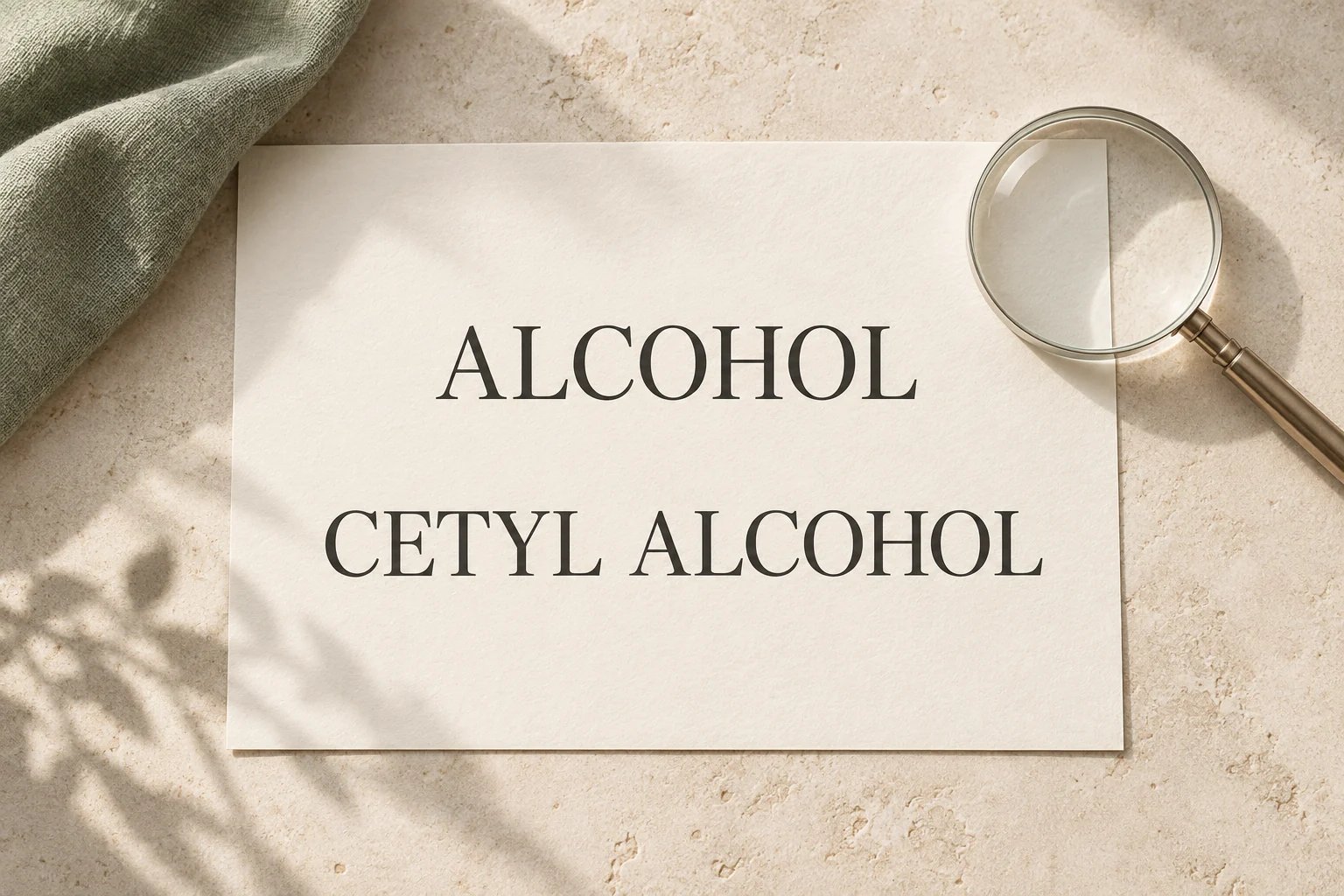
Alcohol in skincare is not one interchangeable ingredient. On a US cosmetic label, Alcohol by itself means ethanol. Names such as Cetyl Alcohol identify different substances. Read the complete name before deciding what the word tells you about a moisturizer.
This guide helps adults interpret everyday cosmetic labels, including an apparent puzzle: an alcohol-free product whose ingredient list still includes an alcohol. It is a naming guide, not a rating of individual products or a treatment recommendation.
Start with the full ingredient name
The FDA explains the distinction between ethanol and other cosmetic alcohols:
- Alcohol: ethyl alcohol, also called ethanol.
- Alcohol Denat. or SD Alcohol: denatured ethanol. A denaturant makes it undrinkable; SD names may include a number or letter combination.
- Cetyl Alcohol, Stearyl Alcohol, or Cetearyl Alcohol: examples of fatty alcohols, a different group from ethanol.
These examples do not cover every cosmetic alcohol. Do not assign an unfamiliar name to either group by guesswork.
An alcohol-free claim commonly refers to the absence of ethanol, not every member of the broader alcohol family. FDA notes that products with this claim may still contain fatty alcohols. Finding cetearyl alcohol is therefore not, by itself, evidence that the front label contradicts the ingredient list.
Why might a moisturizer contain fatty alcohols?
Fatty alcohols can help a cream function as a cream. The published Cosmetic Ingredient Review report on fatty alcohols describes uses including softening skin, helping stabilize emulsions, and controlling thickness. Those are formulation roles, not proof that one finished moisturizer will outperform another.
Cetearyl alcohol is a mixture of cetyl and stearyl alcohol. The British Society of Cutaneous Allergy describes it as a wax found in personal-care products. This is a useful reminder that a shared word in ingredient names does not make the ingredients identical.
For the broader jobs a moisturizer can perform, our guide to humectants, emollients, and occlusives separates ingredient roles without turning them into a shopping score.
Try a three-field label note
Rather than making an avoid list from one word, record three pieces of information. This is an organizational exercise, not a skin test:
- Exact wording: Copy the complete ingredient name and the precise front-label claim. Do not shorten “Cetyl Alcohol” to “alcohol.”
- What is established: Record the ingredient identity you can verify. Keep that separate from assumptions about the product’s feel or performance.
- What remains unanswered: Write one question for the manufacturer if the label is unclear, including the exact product and version.
For example, imagine a moisturizer labeled alcohol-free that lists cetearyl alcohol. The naming distinction can explain that combination. It cannot tell you whether you will like its texture, whether it fits your budget, or whether it will feel comfortable on your skin. Those are separate decisions.
Our ingredient-list guide explains another limit: ingredient order does not give you a complete recipe. Do not assign a concentration simply because an alcohol appears near the beginning or end of a list.
Keep identity separate from personal suitability
“Fatty alcohol” is not a promise that a product cannot cause a reaction. The British Society of Cutaneous Allergy’s information also documents contact allergy to cetearyl alcohol. The point is not to diagnose yourself from a label, but to avoid replacing one blanket rule with another.
If a product repeatedly causes discomfort, seek individual advice rather than using this naming guide to identify the cause. A familiar ingredient name is not a reason to ignore how a product feels. You also do not need to replace a comfortable moisturizer merely to build a shorter-looking ingredient list.
Keep the final decision connected to your simple skincare routine: a clear purpose, understandable directions, and a product you can use comfortably.
Sources and editorial note
Sources were checked on October 31, 2026. Cosmetic-label terminology here is US-focused; the British clinical source supports ingredient identity and the limits of individual tolerance, not US labeling rules. This educational article was prepared with AI assistance and checked against the linked sources. It has not been reviewed by a dermatologist. No products were tested. The cover is an AI-generated conceptual illustration, not real packaging. Read our Editorial Policy.