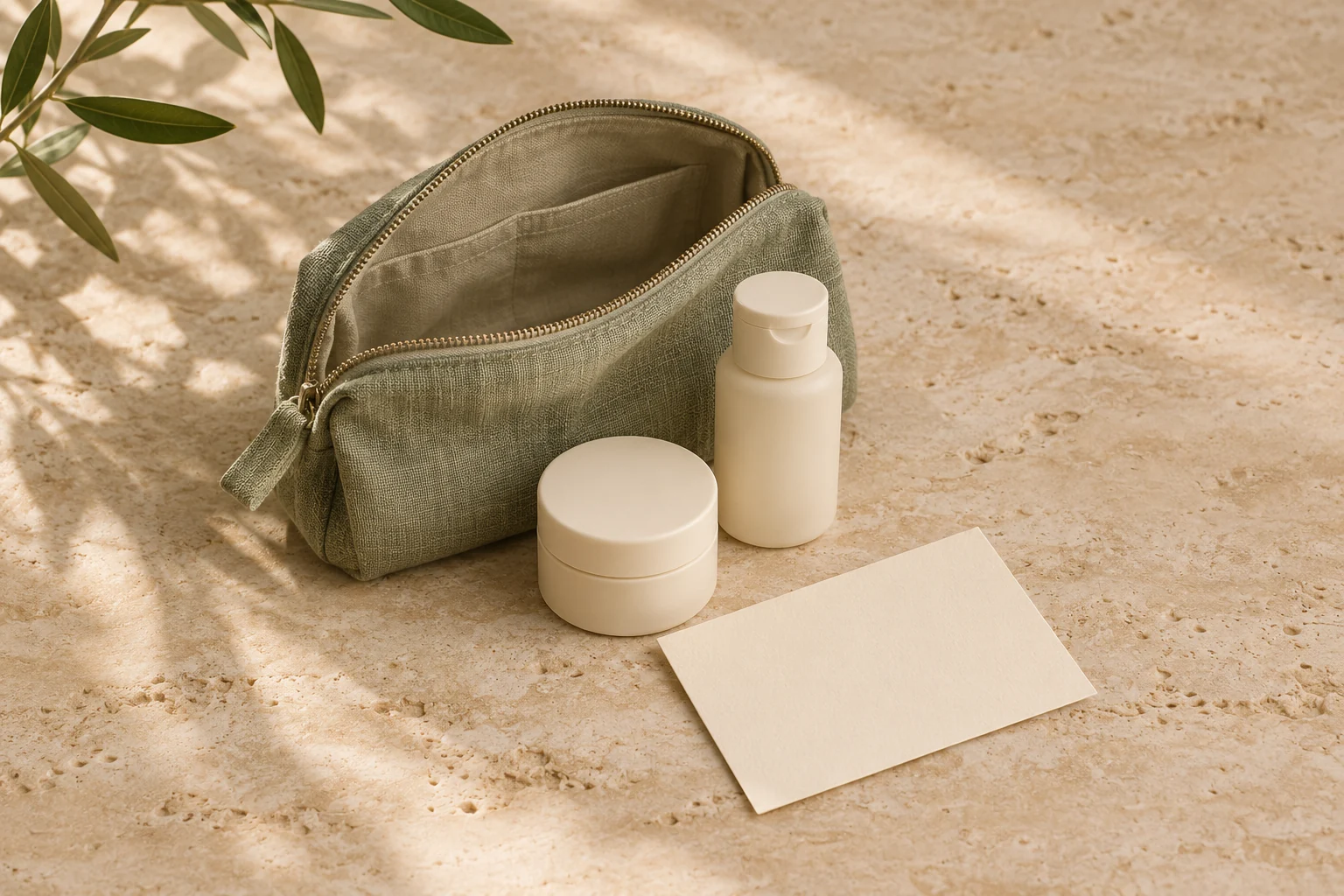
For travel-size skincare, a manufacturer-filled mini is a straightforward way to keep a familiar product in its supplied packaging. If you want to decant a cleanser or moisturizer, check the product maker’s guidance rather than assuming any small bottle will suit it. Keep sunscreen in its original packaging.
This US-focused guide helps adults pack everyday cosmetic skincare. It focuses on choosing containers and keeping directions available, rather than airline rules, prescription products, or building a new routine for a trip.
Start with familiar products
The American Academy of Dermatology’s travel guidance recommends bringing your usual skincare products and includes cleanser and moisturizer in travel-size containers on its packing list. A smaller bag does not require an unfamiliar collection of samples.
Before buying containers, lay out the products you actually use. Our basic routine guide can help you separate essentials from optional extras. Then decide how to carry each item. This keeps the packing decision tied to your routine instead of the number of empty spaces in a matching travel set.
Separate a ready-filled mini from an empty travel bottle
A manufacturer-filled mini comes with a particular product already inside its supplied container. An empty refillable bottle leaves you with an additional question: does the product maker support transferring that formula into it?
Packaging deserves that question. The FDA identifies inadequate packaging and handling during use among the ways cosmetics can become contaminated. This does not establish that every transfer is harmful, or that all refillable containers are unsuitable. It does mean that capacity alone is an incomplete way to choose.
For a cosmetic you want to decant, ask the maker about the exact product, the proposed container, and how long you intend to keep it there. Look for product-specific filling, cleaning, and storage instructions. If that guidance is unavailable, keeping the supplied packaging is a practical way to avoid guessing. This is an editorial packing preference, not a universal prohibition on transferring cosmetics.
When buying a mini, compare its exact product name and directions with what you use at home. Keep any carton or leaflet that carries information missing from the small container.
Give sunscreen its own packing decision
The Skin Cancer Foundation’s Photobiology Committee recommends travel-size sunscreen in its original packaging or buying sunscreen at your destination, rather than transferring it. Its explanation is specific: the intended packaging helps protect the formula and maintain stability.
Apply this precaution to your SPF moisturizer too: keep it in the packaging it came in. Read the sunscreen directions rather than treating it as another cosmetic to portion into a matching pot. Our sunscreen label guide explains the separate protection claims and directions.
Make a packing decision for each product
Use this short checklist before closing your bag. It is an organizational aid, not a test of product stability.
- Choose the format. Record “supplied packaging,” “manufacturer-filled mini,” or “transfer following product-specific guidance.” Keep sunscreen in the first two groups.
- Keep the identity clear. Put the exact product name on any permitted refill. Save readable photos of its ingredients, directions, warnings, and any printed date so those details travel with you.
- Keep dates distinct. Record the original opening date separately from any transfer date. A transfer note is bookkeeping; it does not establish a new usable period. Ask the maker if that period is unclear.
- Check the closure and destination. Confirm the cap closes properly and that you can follow the storage instructions during the trip, not only at home.
The FDA advises following labels, keeping containers clean and tightly closed, and protecting cosmetics from temperature extremes. For date symbols and longer-term organization, use our skincare shelf-life guide. You do not need a new expiration chart simply because you are packing a suitcase.
Sources and editorial note
Sources were checked on November 4, 2026. This educational guide was prepared with AI assistance and has not been reviewed by a dermatologist. No products or travel containers were tested. The checklist is an editorial planning aid. The cover is an AI-generated illustration, not a product recommendation. Read our Editorial Policy for sources and disclosures.