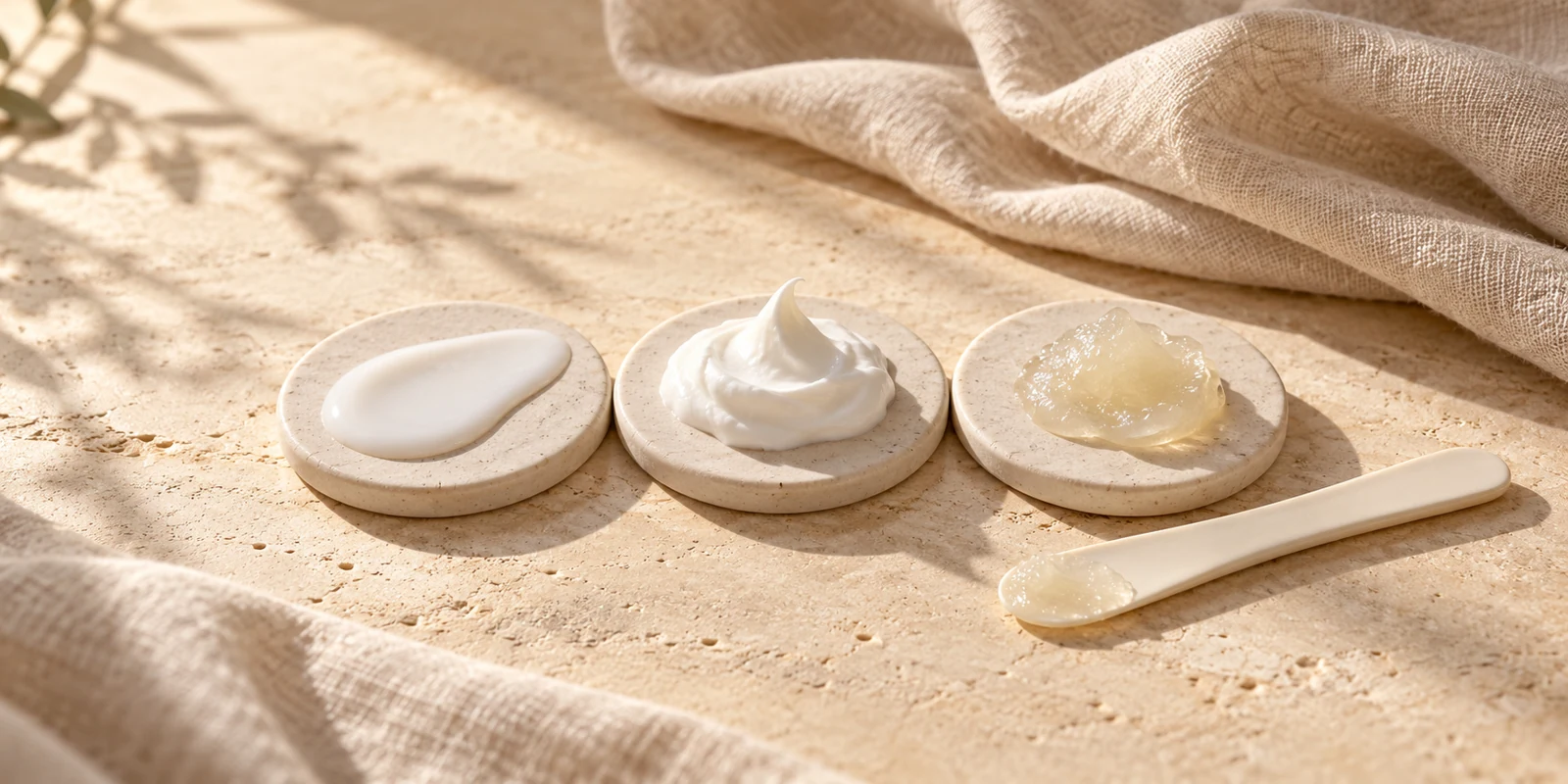
Start with the texture that matches the area you want to moisturize. A lotion is a lighter option for mild dryness; a cream is a richer starting point for dry skin; an ointment provides a heavier, more protective layer but can feel greasy. These are useful categories, not promises about every formula. The American Academy of Dermatology explains the main texture differences.
You do not need one of each. This guide helps adults compare everyday moisturizers without building a longer routine or chasing a single fashionable ingredient. If your current product is comfortable and does the job, there may be nothing to replace.
Compare the texture before the ingredient headline
Use this table to make a shortlist, not to diagnose your skin or select treatment for a condition.
| Texture | A practical starting point | Trade-off to consider |
|---|---|---|
| Lotion | Mild dryness or an area where easy spreading matters | A lighter feel may not provide enough comfort for a very dry area. |
| Cream | Dry skin when a lotion feels insufficient | Richer than a lotion, but usually less greasy than an ointment. |
| Ointment | A small, dry area where a heavier protective layer is welcome | The greasy finish may be inconvenient on exposed skin or under clothing. |
DermNet’s moisturizer guide describes ointments as more occlusive than creams, with lotions generally lighter. “Occlusive” means helping slow water evaporation from the skin’s surface. The AAD’s dry-skin guidance also favors creams or ointments over lotions for dry skin.
The useful question is not “Which texture is strongest?” It is “Which texture suits this area and feels practical enough to use?” You might prefer a lighter finish during the day and a richer one on a dry area at another time. That is an option, not a requirement to buy two products.
Read the label in three passes
1. Check the intended use and directions
Confirm where the product is meant to be used, then read its instructions and warnings. A large body-moisturizer bottle and a small facial cream are not automatically interchangeable simply because both say “moisturizer.” Let the label guide intended use rather than the package size or price.
Our face moisturizer versus body lotion guide walks through that comparison, including intended use, texture and price, without assuming every face and body formula is interchangeable.
2. Look beyond “unscented”
For dry or easily irritated skin, the AAD recommends fragrance-free products. “Unscented” is not the same assurance: the FDA explains that some unscented cosmetics contain fragrance to mask other odors. If fragrance is a concern, read the ingredient list as well as the front label; ask the manufacturer if its description is unclear.
Nor is “hypoallergenic” a personal safety guarantee. In the United States, FDA says the term has no federal standard or definition. Treat it as a claim to examine, not a reason to ignore a known sensitivity.
3. Use ingredients as clues, not a scorecard
Moisturizers can combine humectant, emollient, and occlusive roles in one formula:
- Humectants, such as glycerin, attract and retain water in the outer skin layer.
- Emollients help skin feel softer and smoother.
- Occlusives, such as petrolatum or dimethicone, help reduce water loss.
These roles are explained in DermNet’s ingredient overview. Finding a familiar ingredient is useful, but it does not tell you how the finished product will feel. For the structure these products help care for, see our explanation of the skin barrier and water loss.
For US retail cosmetics, ingredients generally appear in descending order of predominance. Ingredients at 1% or less can appear in any order, and color additives have an exception too, according to FDA’s labeling summary. You cannot reliably turn a list into exact percentages or conclude that the last-listed ingredient is ineffective. For an example of how to assess an ingredient claim, see our ceramides in skincare guide.
Make a one-product decision
Before buying, finish this sentence: “I want a moisturizer for ___, and my current option is ___.”
For example, “I want a moisturizer for my hands, and my current option feels too light” points toward comparing richer textures. “My current moisturizer is comfortable, but a new ingredient is popular” does not identify a problem that needs another purchase.
Compare two candidates using the same four questions:
- Is it intended for the area I want to use it on?
- Does the texture fit my preference and the dryness I am addressing?
- Are the ingredients and directions compatible with sensitivities I already know about?
- Is the price manageable for regular use?
Keep the rest of your simple skincare routine uncomplicated while assessing a new product. For ordinary dry-skin care, applying moisturizer after gentle washing while skin is still damp can help retain moisture; both AAD and DermNet support this timing. Follow the product’s directions.
If dryness persists, becomes painful, or products repeatedly sting, ask a dermatologist rather than continually buying heavier formulas. A texture guide cannot determine the cause.
Sources and editorial note
Sources were checked on October 25, 2026. Labeling information here applies to the United States. This educational article was prepared with AI assistance and checked against the linked sources; it has not been reviewed by a dermatologist. No products were tested for this article.
Read our Editorial Policy for how we handle sources, AI assistance, and corrections.
The conversation