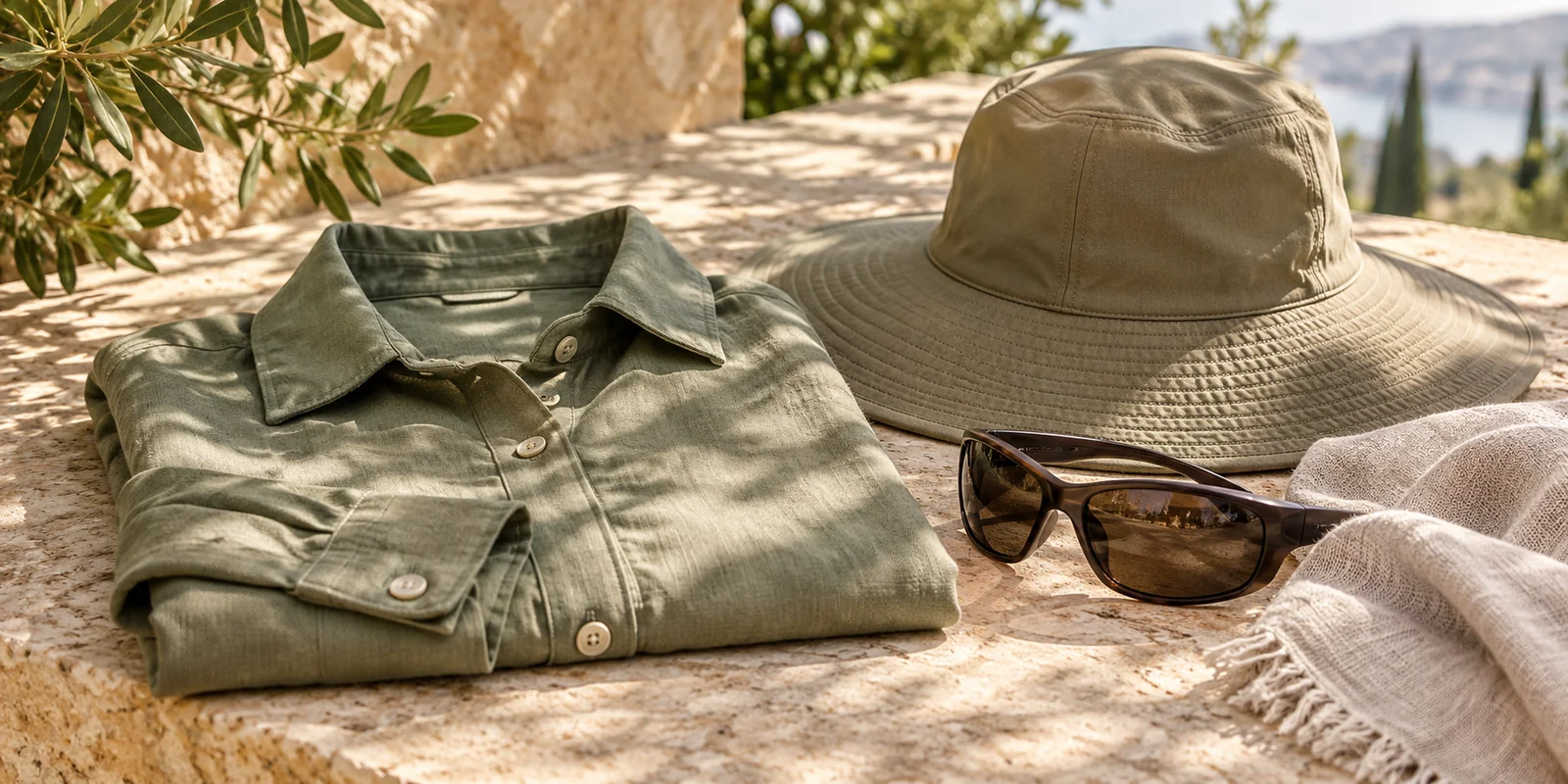
Sun-protective clothing works best as part of a plan: cover more skin, check how the garment fits, and use shade and sunscreen for protection that clothing alone cannot provide. A UPF label helps describe the fabric; it does not tell you whether your ears, hands, or neckline are covered.
This guide is for adults planning everyday outdoor activities in the United States. It focuses on what to wear and where to sit or walk—not on choosing sunscreen ingredients or treating a skin condition.
UPF and SPF answer different questions
UPF stands for ultraviolet protection factor. It describes how much ultraviolet radiation, including UVA and UVB, passes through a fabric. The Skin Cancer Foundation's clothing guide explains that UPF 50 fabric allows about one-fiftieth of the UV radiation through. That rating concerns the fabric, not uncovered areas of your body.
SPF is the sunscreen measure of relative sunburn protection. The FDA explains that SPF compares the UV exposure needed to produce sunburn with and without sunscreen. It is not a multiplier for how long you can stay outside.
Use the two labels for different decisions: UPF when assessing a garment's UV protection; SPF, broad-spectrum labeling, and directions when choosing sunscreen. Do not add the numbers together or treat a rated shirt as permission to skip protection elsewhere. Our sunscreen label guide covers that separate shopping decision.
Start with coverage, then inspect the fabric
The American Academy of Dermatology's clothing guidance recommends lightweight long sleeves and pants, a wide-brimmed hat, and sunglasses with UV protection. It favors dense fabric over open weaves such as lace and recommends looking for a UPF number.
Translate that into a try-on check. Reach forward, sit down, and lift your arms: which areas become exposed? A shirt that looks generously cut on a hanger may leave gaps during the activity you actually plan to do. This is a coverage check, not a home test of its UPF.
Fit matters too. The Skin Cancer Foundation notes that stretching fabric can open spaces between fibers and reduce protection. Favor a comfortable fit rather than relying on a garment stretched tightly across your skin.
For swimming, check the garment's intended use and any information about protection when wet. AAD cautions that wet clothing can offer less protection than dry clothing. Do not assume an ordinary shirt performs like purpose-made swimwear, or invent a wet-use rating when the label gives none. Ask the manufacturer if a claim is unclear.
Check the accessories and the gaps
A broad brim provides coverage around the head that a baseball cap does not. AAD also cautions that dark sunglass lenses do not necessarily provide UV protection: read the label rather than judging the tint.
Before leaving, look at what your outfit still exposes. Hands, the neckline, ears, and the tops of feet may need attention. The FDA advises applying sunscreen to uncovered skin and emphasizes that sunscreen does not block all UV radiation.
For sunscreen selection, this guide follows the AAD recommendation: broad-spectrum, water-resistant SPF 30 or higher on skin not covered by clothing. Reapply every two hours outdoors and after swimming or sweating, following the product's directions.
Treat shade as another layer, not a complete shield
Shade is useful, but UV can still reach you from the sides, through gaps in foliage, and by reflection. The Skin Cancer Foundation's sun-protection guide explains these limitations.
Choose a shaded place for a break, then check whether your whole seated position is actually within it. Recheck when you move or the shade shifts. A covered table does not necessarily mean that your legs are covered too. Keep your clothing and sunscreen plan in place rather than treating the umbrella as a substitute.
A before-you-go decision checklist
Use this short planning note rather than a shopping score:
- Activity: What will I be doing, and will my clothes get wet or stretch?
- Coverage: What stays covered when I sit, reach, or walk?
- Label: Is there a UPF rating, and what use or care instructions accompany it?
- Gaps: Which exposed areas need sunscreen, and have I checked my hat and sunglasses?
- Location: Where can I find shade, and can I move if it no longer covers me?
- Follow-through: Have I packed what I need to follow the sunscreen's reapplication directions?
Start with what you already own. The useful purchase is one that fills a specific gap—not an entirely new wardrobe because you learned a new label term.
Sources and editorial note
Sources were checked on October 27, 2026. This educational guide was prepared with AI assistance and checked against the linked sources. It has not been reviewed by a dermatologist. The cover is an AI-generated illustration, not a photograph of tested products. No clothing, sunglasses, or sunscreen products were tested for this article. It does not replace individual medical advice.
Read our Editorial Policy for how DermiBun prepares its guides.
The conversation